How South African wealth keeps family & legacy safe in an unstable environment
Topics
The 2018 spike - an introduction - jump to this section
Business leaders are leaving, but why? - jump to this section
Case study - How some can leave, and others can't - jump to this section
A step-by-step case study of how business leaders and executives that have built some capital secure their families and their future.
Imagine this: You've worked your entire life trying to make the best of it, kept going against all odds, built something great and now, you have something to show for it.
When that's the case for you, you know you don't want to put whatever you've built at risk. This includes your business, your career, and even your family.
So when you're living in a country with an unstable political climate, social instability, and many other issues, you're going to want to do something about it. This is no different for South Africa, and in 2018 there was a sudden spike of people leaving the country.
But how are they leaving?
In this case study, we decided to gather what we know and look at actual cases of people taking advantage of this possibility. We’ll look at what drove them, how they did it and finally, the pitfalls and things they had to watch out for.
People with money are leaving, and with good reason
What is driving this?
Before we go into a specific case, it's interesting to note that the majority of people all seem to leave for more or less the same reasons.
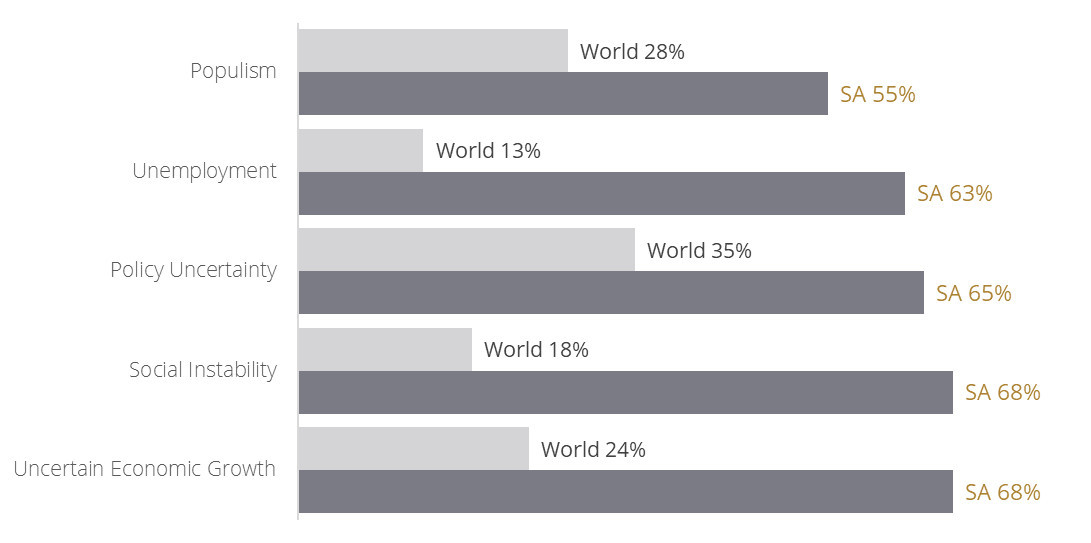
Some may have different priorities, but the main issues always seem to come back, one way or another. We've covered this in a previous report, but this graph tells you quite a bit already:
The chart shows you a comparison between what threats CEOs all across the world can see as a potential issue versus what CEOs in South Africa see.
The difference is huge and it certainly has its impact. In fact, also covered in the previous report, we found that 86% of executives would leave the country if they could. That's a lot.
When you look at the drivers, you can categorize into 2 main categories:
They want the best for their family, and that's only normal. But lackluster social security and an even worse schooling system doesn't make that all too easy.
So the prospect of being able to benefit from best-in-class health care and schooling, all for just being a citizen in a different country, is often enough to make the move.
Protect their family and provide a better future for their children
As a citizen of South Africa, there are certain business deals out of your reach. In fact, many real estate opportunities are just not on the table.
Being able to invest and do business in a stable environment like Europe is a great perk on its own, but add to that the fact that they no longer require a visa to travel to many countries and the move becomes a no-brainer.
More business opportunity and more freedom to travel
So, South African business leaders are leaving the country. But what sets them apart from everyone else? Why are they the ones leaving?
Well, it all comes down to opportunity.
Some need to wait for a job opportunity, some don't. And it's the ones that don't that are able to make the move whenever they want to, on their terms.
All they need to know, is "How?'.
And that's what we're going to be looking at in this case study. Specifically, we'll cover a case where the primary motivation was to secure a better life and future for the family as well as to secure their legacy.
A case study - Securing a better future for the Family

Reserve a seat
Mark's story - Why he needed to make a move
Just like so many others, Mark had worked all his life to get to where he is now. That means a lot of sacrifices and work to make sure he had the life he wanted.
Now, it was time to give his family the life they deserved.
But, living in an unstable political and social climate, he felt like he couldn't really make that happen.
The school system was lacking in quality, there was always a feeling of insecurity, and perhaps worst of all was the fact that just because they didn't have "the right" nationality, like say most European nationals have, they weren't as free to go where they wanted (or needed) to go.
This was not just a problem for him, but also his wife and two children. And while private school and cautious living helped, the situation was far from ideal.
The problem, as with anything, was that he didn't know what his options were. This is not something you learn about in school. It was only after a friend referred him to an expert that he could think about changing his life and the future of his family.
TAKEAWAY 1
Have someone consult you
If you're like most people, this is not your main focus. There's some information out there, but most of it is fairly limited. Your options range from government programs to custom deals and finding what works best for you and your needs requires someone who is who is very familiar with this.
Understanding his options
The idea behind everything is simple: If you want the same privileges as those born in Europe, your only way in is to become "European". That means getting a secondary citizenship which you can then leverage for a whole slew of perks.
The problem is: How do you get that citizenship?
Luckily countries like money and some cases, that brings with it some opportunities for those who have it.
Now, you don't need to be ultra-wealthy, but you do need to have some capital available to either invest or in some cases outright buy your citizenship. When you do have capital available, the possibilities are endless. (here's a quick test that tells you immediately if you might qualify or not)
There are basically three avenues you can take:
Some countries are very clear about it. If you have a certain amount of money burning a hole in your pocket, this may be for you.
Quick and easy, but no return on investment
1. Pay your way into it
2. "Evergreen" deals
There are funds, companies, and projects available that are basically always there. You invest and in return, you get your citizenship.
Return on investment! More choice and varied contribution requirements.
3. Temporary deals
Temporary projects that require investors and are happy to give some perks in return.
Return on investment! Even more choice to suit different people, and sometimes the lowest possible contribution requirements.
Going back to our case study, Mark did want to have a return on investment and not just put his money into a fund to never see it again.
In addition, Mark did have one very strict requirement:
Benefits of the investment should also apply to his family.
This is important, because not all opportunities have the same perks. Instead, you're going to need to sit down with someone who you can walk through your requirements so they can find the deal that suits you best, ticking as many boxes as possible, within your means.
TAKEAWAY 2
Not all deals are created equal
Each opportunity is different, and it's important to match your requirements with the deals available within your means.
Be sure to consider temporary deals - they often offer very specific perks, so you can choose one that suits your needs.
In fact, in Mark's case, after sitting together with an expert, and identifying what possibilities were within his means Mark outlined the following requirements:
Main requirements
"Nice to have" requirements
The most important part is being able to match an opportunity with your requirements. Since choosing the right program or investment can have such an impact, having someone to guide you through it is often a must have.
This is especially important when you want to take advantage of often lucrative, but temporary deals.
These temporary deals are often real estate projects that require an initial investment and are only open until they've hit their maximum investor buy-in.
Taking advantage of something like this does require an expert to always keep an eye open for opportunities so they have a regular flow of projects that allows them to help investors with their specific requirements.
In Mark's case, his requirements pointed him towards choosing a temporary deal. As a bonus, he was able to get a lower minimum invested amount as well. In his case, the deal was limited to up to 2 children, but that was ideal for him.
Now, his wife, his 2 children, and he himself had a secondary passport in a European country, with all the benefits that came along with it.
Outside of the standard benefits, that come with a European citizenship, this allowed his children to go to school in a European school, with very high standards, as well as university. All this would even be covered by social security.
In the end, he ended up with a return on an investment that cost him less than private school would have normally cost him.
When you found the right deal
TAKEAWAY 3
In some cases it's even cheaper
Some investments give you a very fast return, simply because you're saving on certain expenses or because additional business opportunities open up to you.
It's important to take this into account as well when choosing an opportunity as it might give you more options.
A summary: The typical process
When you get started, you only need to know two things:
The first question is easy to answer, but absolutely crucial.
After all, there’s no reason in looking any further if you’re not eligible. While it’s not for everyone, you would be surprised at how little it takes to take advantage of these programs.
The second question is something different. It requires some insight and although some options are straight forward, the best deals rarely are.
Here’s how you go about finding what works.
Step One – Set your ground rules
Know what you want.You’re going to be surprised at the possibilities and the overwhelming amount of options available.
The best way to tackle that is to know exactly what you want and what you need. Look at the most crucial stuff, but also what’s optional and nice-to-have. Whatever you do, don’t hold back and think things through.
You may have already decided to have your kids go to private school, but now, it may not even make sense anymore to pay for that. It just so happens that many deals also give your kids the privilege to go to a local school, including university for a fraction of the cost but with the same (or better) quality.
Step Two – Confirm what you’re eligible for
Just to get an idea on if you qualify or not, this quick test already tells you a lot. But of course, since the possibilities are seemingly endless, you’re going to want to talk to someone and go through your requirements line by line to figure out what your possibilities are.
Don’t forget to take temporary deals into account when you’re weighing your options. These are usually limited but can have very specific advantages compared to others.
Step Three – Find the right opportunity
The next step is to go through the opportunities that are available and to see what suits you most. At this point, you’ll also start considering things like location, climate and optimize there as well. While these things are usually secondary to other goals, they’re certainly nice perks.
Remember: Most solutions are an investment, so you should actually expect a return as well.
RELATED
Do The Test: Are Perk Investments within your reach?
There are plenty of benefits, like being able to travel through or do business in Europe without the need for a visa.
Unfortunately, perk Investments are not available to anyone. Do the test and find out if you're one of the lucky few.
Take the test now
Privacy is important. To protect the case study subject's identity, we used a different name to ensure privacy. Thank you for understanding.
Office 404, Building B, Al Saaha Offices, Souk Al Bahar
Old Town Island, Burj Khalifa District, Dubai – UAE
Next Generation Equity
Phone
+971 4 457 8260
enquiry@nge.ae
www.nge.ae